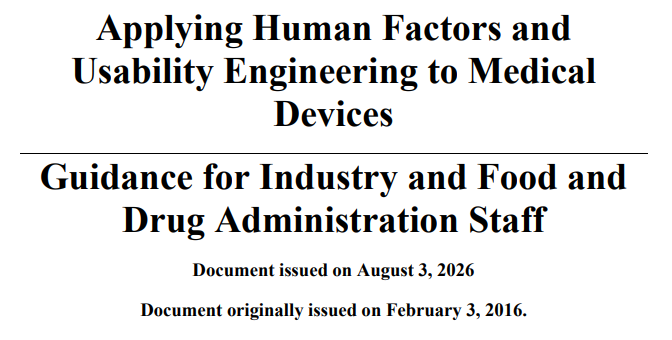
FDA Updates Its Final Guidance on Human Factors Engineering for Medical Devices: What Manufacturers Need to Know
On August 3, 2026, the U.S. Food and Drug Administration (FDA) published an updated version of its final guidance, Applying Human Factors and Usability Engineering to Medical Devices. The guidance has served as FDA’s principal reference for medical device human factors engineering (HFE) and usability engineering (UE) since it was originally finalized in 2016.
The update comes shortly after another important development: FDA’s May 2026 final guidance on Content of Human Factors Information in Medical Device Marketing Submissions. Together, the two documents provide a more complete picture of FDA’s current HFE/UE expectations: one addresses how manufacturers should conduct human factors engineering during medical device development, while the other addresses what human factors information should ultimately be included in a regulatory submission.
For medical device manufacturers preparing a 510(k), De Novo, PMA, or HDE submission, understanding how these two documents work together is increasingly important.
Key takeaways
The update does not fundamentally rewrite FDA’s approach to human factors engineering. The core principles established in 2016 remain: manufacturers should systematically identify and evaluate use-related risks and design their user interfaces to minimize use errors that could result in harm. FDA continues to emphasize the relationship between the intended users, uses, use environments and user interface when evaluating the safety and effectiveness of a medical device.
As such, medical device manufacturers should not interpret the 2026 update as an entirely new human factors process. Activities such as identifying intended users and use environments, conducting task and use-related risk analyses, performing formative evaluations, identifying critical tasks and conducting human factors validation testing where appropriate remain central to FDA’s approach.
What is the purpose of the guidance?
The guidance provides recommendations for incorporating human factors and usability engineering into medical device development to help ensure medical devices can be used safely and effectively by their intended users, for their intended uses, and within their intended use environments.
A central objective remains the identification and reduction of use-related risks. FDA emphasizes designing the user interface to minimize potential use errors and resulting harm.
The user interface extends beyond the physical device itself and includes all points of interaction between the user and the device, including controls, displays, alarms, packaging, labeling, instructions for use, and training.
Human factors remains an integral part of risk management
The updated guidance continues to position HFE/UE as an integral part of the medical device risk-management process.
A key component of this process remains the Use-Related Risk Analysis (URRA). Manufacturers should systematically identify how interactions between intended users, the user interface, and the use environment could lead to use errors, hazardous situations, and potential harm. The URRA provides an important foundation for identifying critical tasks and determining where additional risk controls or usability evaluations may be necessary.
Manufacturers should therefore understand the characteristics of their intended users, use environments, and user interface, and use these insights to guide device design and risk-control measures.
Formative evaluations can be used throughout development to identify and address usability problems, while human factors validation is used to demonstrate that the final user interface supports safe and effective use.
FDA’s expectations for HFE documentation have also evolved
Importantly, the regulatory landscape surrounding the guidance has changed since the original version was published in 2016.
FDA now provides more specific recommendations regarding the human factors information expected in medical device marketing submissions in the seperate guidance Content of Human Factors Information in Medical Device Marketing Submissions. Specifically, FDA’s companion guidance includes updated sample structures for HFE/UE reports, with separate appendices for different submission categories.
This means manufacturers should not simply continue using the report structure contained in the former 2016 Human Factors Guidance without considering FDA’s newer recommendations.
What does this update mean for medical device manufacturers?
The August 2026 update reinforces an established FDA principle: human factors should be incorporated throughout medical device development rather than addressed only shortly before regulatory submission.
While the core principles of medical device human factors engineering remain familiar, FDA’s current expectations regarding how HFE activities and results are documented and presented have evolved.
For companies preparing an upcoming FDA submission, now is therefore a good time to ensure both the HFE process and the resulting documentation reflect FDA’s current expectations.
Need help navigating the updated FDA human factors expectations?
Human Factors Insight supports medical device manufacturers throughout the HFE process, from use-related risk analysis and formative evaluations to HF validation and submission-ready documentation.
Not sure what the updated guidance means for your device or upcoming FDA submission? Get in touch, we’re happy to discuss your human factors strategy.
View FDA’s August 2026 Human Factors Guidance
View FDA’s current HFE/UE report structure and submission guidance
How can we help?
Schedule a free consultation or request a quote for your human factors and usability engineering needs.
Contact Us
info@hf-insight.com